Home/Technology/Europe's free satellite service just made it easier to track wildfires

Europe's free satellite service just made it easier to track wildfires

TechnologyAugust 8, 20261 min readAttributed summary
Europe's free satellite service just made it easier to track wildfires
Copernicus Browser adds wildfire visualization amid record wildfire season.
Reading Settings

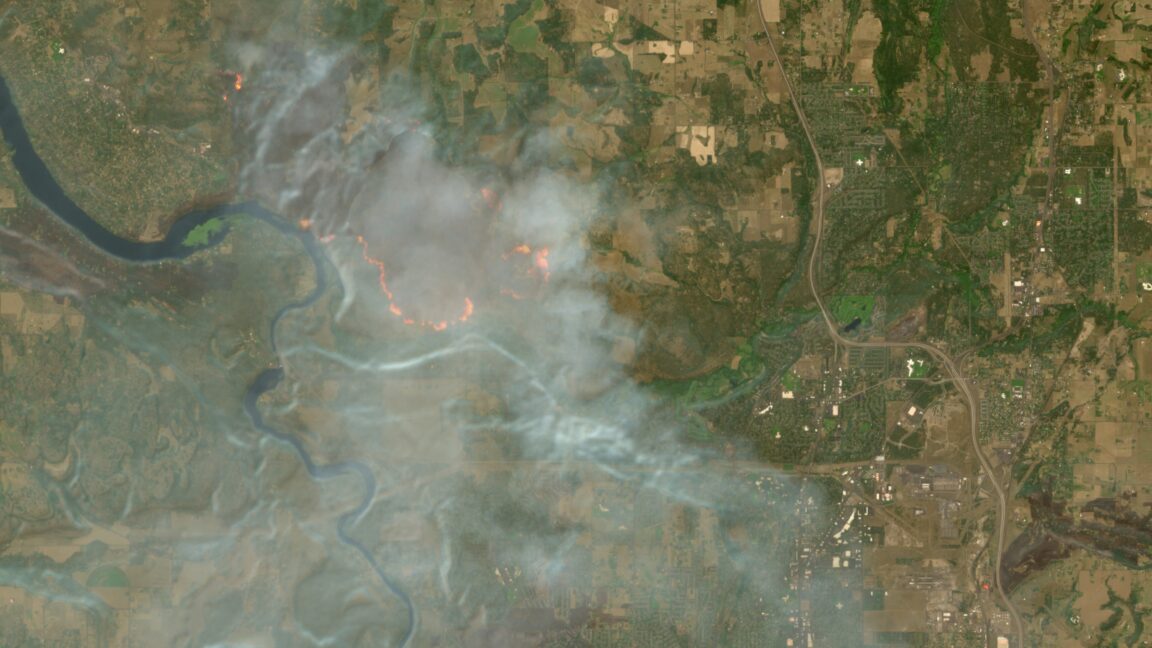
The wildfires afflicting communities across the world can now be tracked more easily by anyone using Europe’s free and open satellite imagery service—all thanks to a wildfire visualization script originating from nearly a decade ago.

The Copernicus Browser provides free access to the latest satellite imagery taken by the European Space Agency’s Sentinel satellites for the European Union’s Earth observation program. The three satellites of the Sentinel-2 mission have proven especially useful for wildfire monitoring by providing multi-spectral imaging at resolutions as granular as 10 meters in visible light and near-infrared bands—and the Copernicus Browser previously offered 10 default visualization layers using different combinations of spectral bands.

Now Copernicus Browser has also added a straightforward “wildfires” visualization layer for Sentinel-2 imagery that went live on August 4. Anyone clicking on this layer while looking at a wildfire location can see active fires in white or yellow, burning vegetation in red, and burned landscapes in dark brown or black.

Read full article

Comments

Source: Ars Technica

Related technology stories

Raising the quality of insights in agentic analytics
Sourced report
technologyreview.com27 minutes ago

Raising the quality of insights in agentic analytics

In just a few years, generative AI has changed the face of enterprise analytics, notably by making analytics accessible to users across the organization. Agentic AI promises to do even more, by automa

4 min briefingRead signal →
The agentic web is here
Sourced report
technologyreview.com27 minutes ago

The agentic web is here

In 2001, a decade after he invented the World Wide Web, Tim Berners-Lee articulated a new vision. Together with two colleagues, he published an article in the magazine Scientific American in which he

20 min briefingRead signal →