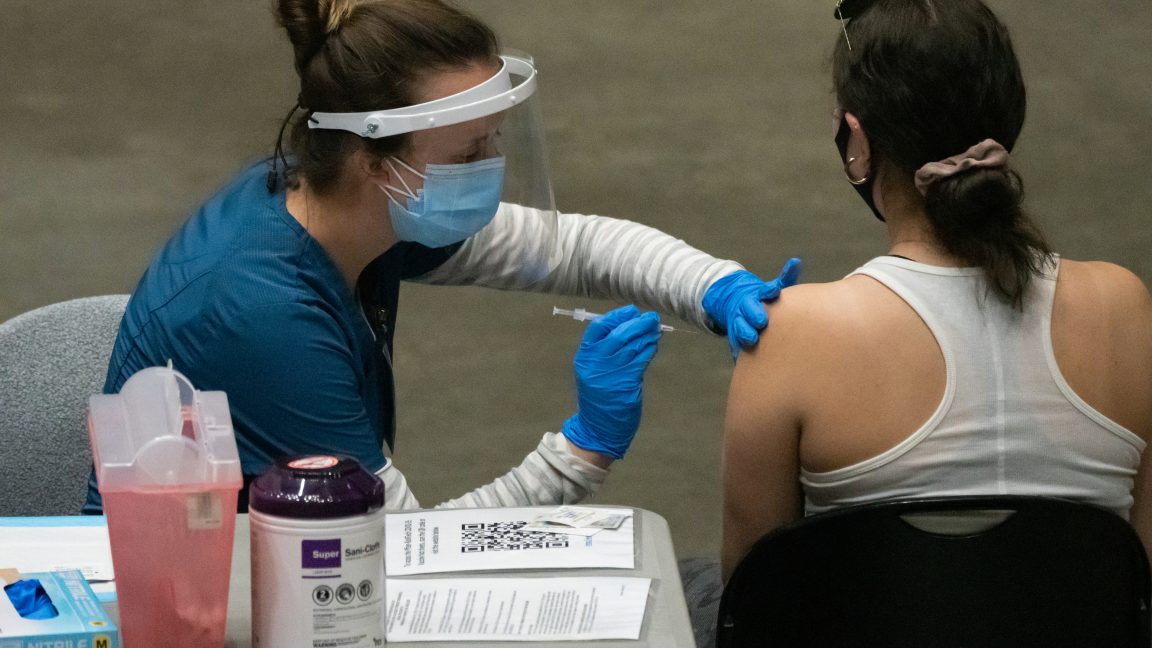
Despite continued benefits, anti-vaccine rhetoric has driven down vaccination.
Although most Americans have eschewed seasonal COVID-19 vaccines, the updated shots continue to show significant protection against cardiovascular disease, especially for those over age 75 and those with underlying medical conditions. That’s according to a new study that pulled data from more than 1 million patients in a US Department of Veterans Affairs (VA) health system.
The finding builds on previous data showing that the vaccines significantly lower the risk of COVID-19-associated cardiovascular risks, particularly heart attacks and strokes. But it wasn’t a given that the benefit would hold up over time—as the virus evolved, the vaccines were updated, population-level immunity increased from previous infection and vaccination, and risk of severe outcomes fell.
The new study, published in JAMA Internal Medicine, found that the 2024–2025 COVID-19 vaccine continued to protect against COVID-19-associated “major adverse cardiovascular events” (MACE), which include cardiovascular death, heart attack, stroke, and hospitalization for heart failure.
The study included electronic medical record data from 1,039,659 patients in the VA’s St. Louis Health Care System. All of the patients received a seasonal flu shot between September 3, 2024, and December 31, 2024, with some also getting a COVID-19 vaccine at the same time. Of the 1,039,659 patients, 349,085 received both shots, while 690,574 got just the flu shot. The latter group acted as the control group for the study.
After eight months of follow-up, the researchers looked for documented COVID-19 cases and compared MACE events among the two groups. Overall, the COVID shots’ vaccine effectiveness against MACE events was 38 percent. In terms of absolute numbers, the benefit is modest. The study estimated that the shots dropped the rate of COVID-19-associated MACE events from about 5 in 10,000 to 3 in 10,000. Looking across subgroups, the benefits were strongest among those aged 75 and older and those with underlying health conditions.
The researchers, led by epidemiologist Ziyad Al-Aly at the St. Louis VA, also looked at MACE and deaths without documented COVID-19 cases. Here, the benefits of COVID-19 vaccines were stronger, suggesting COVID-19 cases may have been missed or undiagnosed. The shots appeared to drop the rate of MACE from 382 per 10,000 to 358, and the rate of death from 223 to 207.
“Extrapolating these estimates to a population of 1 million people, vaccination could plausibly be associated with averting approximately 2,370 MACE events and 1,580 deaths over an 8-month period,” the researchers note, though they urge caution in interpreting the finding.
The study has limitations, including that most of the US veteran population is older, White, and male, making it likely that the findings can’t be generalized to the whole population. Still, the findings indicate that the vaccines continue to offer cardiovascular protection against COVID-19, which should factor into people’s decisions on whether to get an annual COVID-19 booster. An accompanying study also published in JAMA Internal Medicine on Monday found the vaccines still directly protect against COVID-19, reducing the risk of hospitalization and critical illness by 35 percent and 41 percent, respectively.
In an accompanying editorial, Robert Califf, a cardiologist and former Food and Drug Administration commissioner, wrote that the data from the two studies “provide strong evidence of a favorable balance of benefit to risk for updated COVID-19 vaccine boosters across the population.” But, he lamented that despite that strong evidence, national views are being swayed by the “general antivaccination statements from the US Department of Health and Human Services,” which is run by anti-vaccine Health Secretary Robert F. Kennedy Jr.
Only 17.5 percent of adults and 22.6 percent of people over age 65 in the US have gotten the 2025–2026 COVID shot, according to federal data.
“The politicization of COVID-19 vaccination and messenger RNA vaccines in general has taken a toll on the longevity and functional status of those in the US,” Califf wrote. He called for researchers to collect more data on the vaccine’s benefits and engage with the public about the findings, particularly on social media, to combat anti-vaccine rhetoric.
Source: Ars Technica