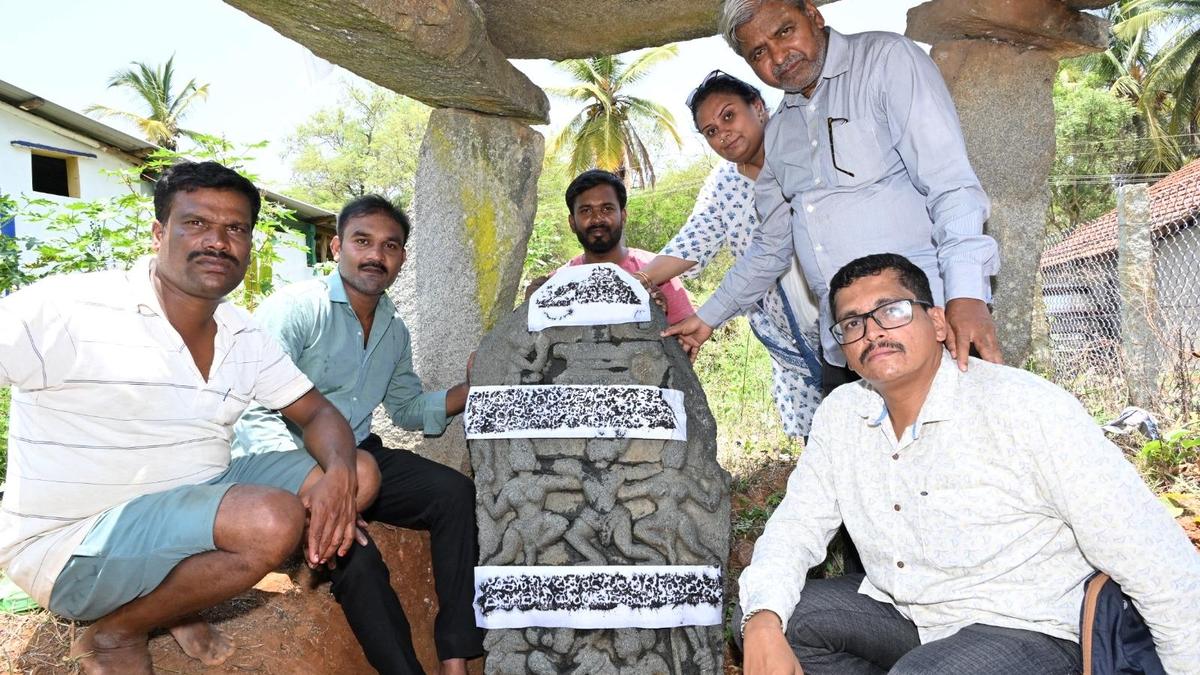
A 12th-century Veeragallu or hero stone dating back to the reign of Hoysala ruler Vishnuvardhana has been discovered in Maniyur village, Nagamangala taluk, Mandya district.
The discovery was described in a press statement by an archaeologist from the Centre of Excellence for Studies in Classical Kannada (CESCK), Mysuru, Shashidhara C.A., as an “unpublished Turugolu Veeragallu” carved out of soapstone that bears an inscription in Kannada, script and language, spread across seven lines. “It is a memorial sculpted to commemorate the bravery and sacrifice of a hero, who died while fighting to protect cattle in the 12th century,” the statement said.
CESCK project director N.M. Talawar pointed out that many brave persons sacrificed their lives while fighting to protect cattle, defend villages, safeguard women’s honour, serve their kings and protect their kingdoms in ancient times. The Veeragallus were installed in memory of such warriors, he said.
“These memorials were meant to proclaim the hero’s bravery and loyalty to the world, inspire others, and elevate the hero to divine status worthy of worship. In some places, shrines were even built around hero stones for worship. Similarly, it has been found at Maniyur that about 900 years ago, during the Hoysala period, a shrine was constructed, and this inscribed hero stone was installed and worshipped in memory of Maviga Manimāra, who died protecting cattle,” Prof. Talawar said in a statement here.
Based on information provided by a resident, Umesh H.L., Dr. Shashidhara visited the land belonging to one Ramakrishne Gowda in Maniyur village situated about 10 km from Nagamangala town and undertook field exploration, leading to the discovery of the Veeragallu.
Researcher Santoshi Subrahmanya, library assistant Nagendra V., and videographer Ramesh Patel, with the cooperation of residents, dug out the hero stone so that the sculpture became fully visible and took a stamp of the inscription.
A statement describing the inscription says it mentions the royal epithets of King Vishnuvardhana of the Hoysalas — Possessor of Five Great Sounds (referring to the ceremonial sounds of instruments such as the drum, conch, kettle drum, trumpet and veena). “The third panel of the inscription contains two lines stating that in the Sādhāraṇa samvatsara, i.e., the cyclic year, Maviga Manimāra, son of Attisetti, died fighting in a cattle raid battle.”
The Veeragallu contains relief sculptures in three panels. “In the lowest panel, the hero is shown stabbing an opponent in the chest with a dagger while the opponent holds a bow. Behind the hero, four cows are sculpted to indicate that the battle was fought for cattle. In the middle panel, the celestial maidens are depicted taking the fallen hero to Kailasa. In the uppermost panel, the dead hero is shown seated before a Shiva linga with folded hands in reverence after attaining Moksha. Above the Shiva linga, relief sculptures of the sun and moon are carved to symbolise that the hero’s bravery and sacrifice will endure as long as the sun and moon exist,” the statement said.
Archaeologist and heritage expert N.S. Rangaraju, commenting on the discovery, said one remarkable aspect of the Turugol Veeragallu inscription is the presence of several titles of the Hoysala King Vishnuvardhana, making it an important subject of research.
Meanwhile, Dr. Shashidhara said our ancestors in earlier times considered cattle not merely as wealth, but as “living treasure”. Therefore, cattle were often raided for political reasons or personal gain.
“In memory of Maviga Manimāra, son of Attisetti, who died fighting to protect cattle, this hero stone was erected. It may also be conjectured that the village itself derived its name “Maniyur” from the hero Maviga Manimāra, perhaps as a mark of respect for his sacrifice and valour”, he added.
Published - May 21, 2026 08:57 pm IST
Source: The Hindu - India News