Dory CEO claims the $149 signs won’t be bricked should Dory go out of business.
Many gadgets marketed as being “smart” make me wonder if they would be better off dumb.
Some examples are smart TVs that insist on sending your activities to businesses to track you, smart fridges that use the Internet to cycle through ads, smart gym equipment that won’t work offline, smart toothbrushes whose batteries drain too quickly, or virtually any gadget that forces you to use a minimally effective or otherwise unimpressive app.
Too often, modern technologies, like inter-device connectivity and artificial intelligence, are shoehorned into gadgets that would be more intuitive to use, affordable, accessible, and/or durable without them.
Dory Sign, however, is a reminder of how technology can improve something as simple as a sign without overshadowing the product’s most basic purpose, which in this case is effective and delightful communication.
Dory is a small sign that, like many E Ink displays, is easy on the eyes because it doesn’t use bright lighting. You control what the sign displays through a free iOS or Android app that doesn’t force you to share your email or name to use it. The app has clear sections for editing the header text, main text, and footer text, adding an image, and choosing a background. It also allows more than one person to make changes to the display and communicates to the sign through Bluetooth.
You can upload your own image or background, but the app comes with a decent range of preloaded images, like animals, flowers, and illustrations, and preloaded backgrounds, including ones that look like brush strokes or marble and more detailed ones, like a landscape. You don’t have to spend a lot of time designing the sign, but if you want to get creative, the app has six different typefaces for text and sliders for text size, line height, letter spacing, and text color (which makes text darker or lighter).
The sign can only display one image, though. And while transferring your preferred text, image, and background is simple enough with the app, your phone has to be pretty close to the sign for it to work. You also have to press the power button every time you want to change the display. This can be tedious, especially if you have the sign mounted to a wall. To be fair, though, manually changing a regular sign also requires you to get close to and touch the display.
The E Ink screen doesn’t lend itself to vibrant imagery. Instead, it’s a more passive display that doesn’t call for attention, yet clearly communicates with distinct detail in its text and images.
At $149, the Dory Sign is expensive for a small display. However, you may be able to extract that much value from it over the years. Dory claims that the sign only uses power when it’s changing what’s on the display. The sign’s contents “remain visible without electricity,” and when the battery dies, “Dory will continue to display the last image shown on the screen,” the gadget’s website says. I haven’t been able to test this, but Dory claims the sign’s battery supports “up to 1,000 updates and 10 to 15 years of battery life.” If true, this is the type of expensive device that could, eventually, earn its keep with enough use.
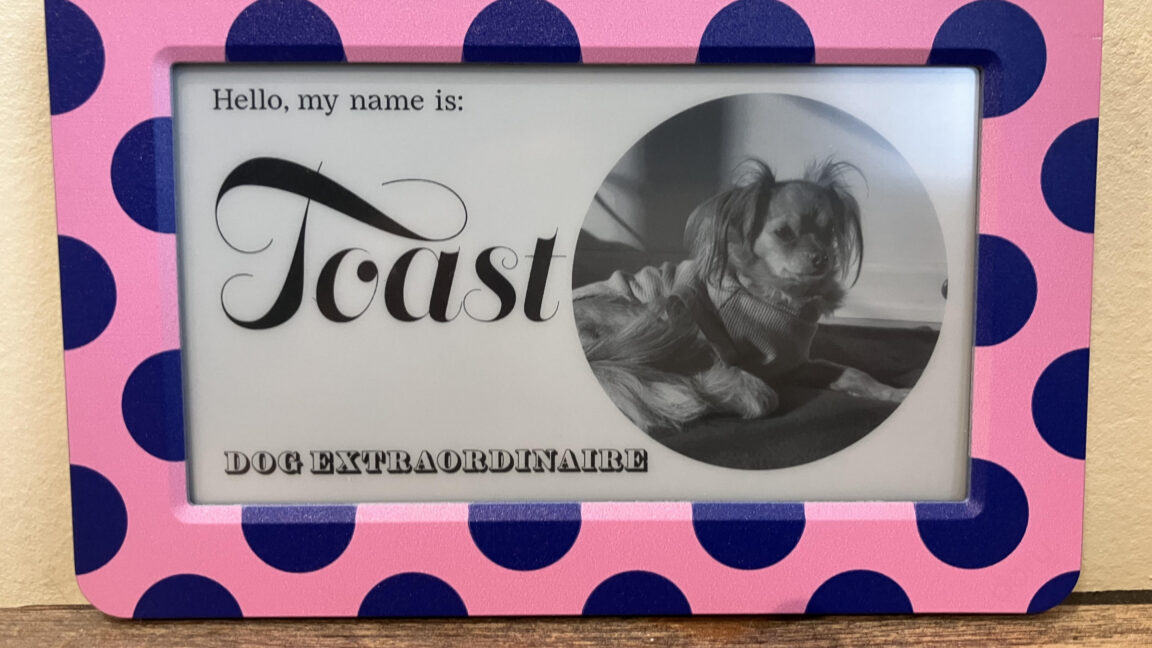
Dory advertises the sign with numerous use cases, including using it as a name placard for offices or apartments or to display QR codes. I found it useful as a “do not disturb” sign for my home office, for displaying instructions for delivery persons, for displaying encouraging messages and reminders in my home office, and for introducing the world to my dog, as shown above.
Dory Sign is IP44-rated, meaning, per the International Electrotechnical Commission, that the sign’s enclosure should withstand solid, foreign objects that are 2.5 mm (0.1 inch) and larger, rain, and spraying and splashing water. So, the sign could survive some outdoor environments, but not extreme ones. You may also think twice about leaving a small $149 device outside where it can encounter other environmental threats or be stolen.
The Dory Sign isn’t a gadget that I’d say anyone “needs.” But I am impressed by its thoughtful, intentional incorporation of technology that enables simple but effective customization, longevity, and variety. You don’t need to be technically advanced to maximize Dory Sign’s usefulness, and its app makes leveraging the sign simpler, not needlessly complicated. I can see why it received Calm Tech Certification, which the Calm Tech Institute gives to gadgets that it says meets its criteria for enhancing “human life without causing stress or distraction.”
As with many smart gadgets, though, I’m concerned that the device could become bricked should Dory ever, for example, go out of business, get acquired, or abandon the product. The sign’s app dependence means that the $149 device would essentially be bricked if the app were to close. I’d prefer if the sign had some manual controls to ensure that it could last as long as its battery, even if the company behind it doesn’t.
I told Thomas Ramberg, Dory’s founder and CEO, about my concerns and he responded via email:
The battery could last for 15-20 years before replacement, and the sign should then be workable for additional decades in theory. Yes, in the (sad) case we would not be around in some years, we will [definitely] keep the app and functionality available. It is [a] fairly modest [expense] to keep the software running.
I (and we) are personally invested on many levels, and it is important to keep people who put [trust] in us happy. Additionally, many of our friends and families have bought a sign, so we’re in it for the long run.
Source: Ars Technica